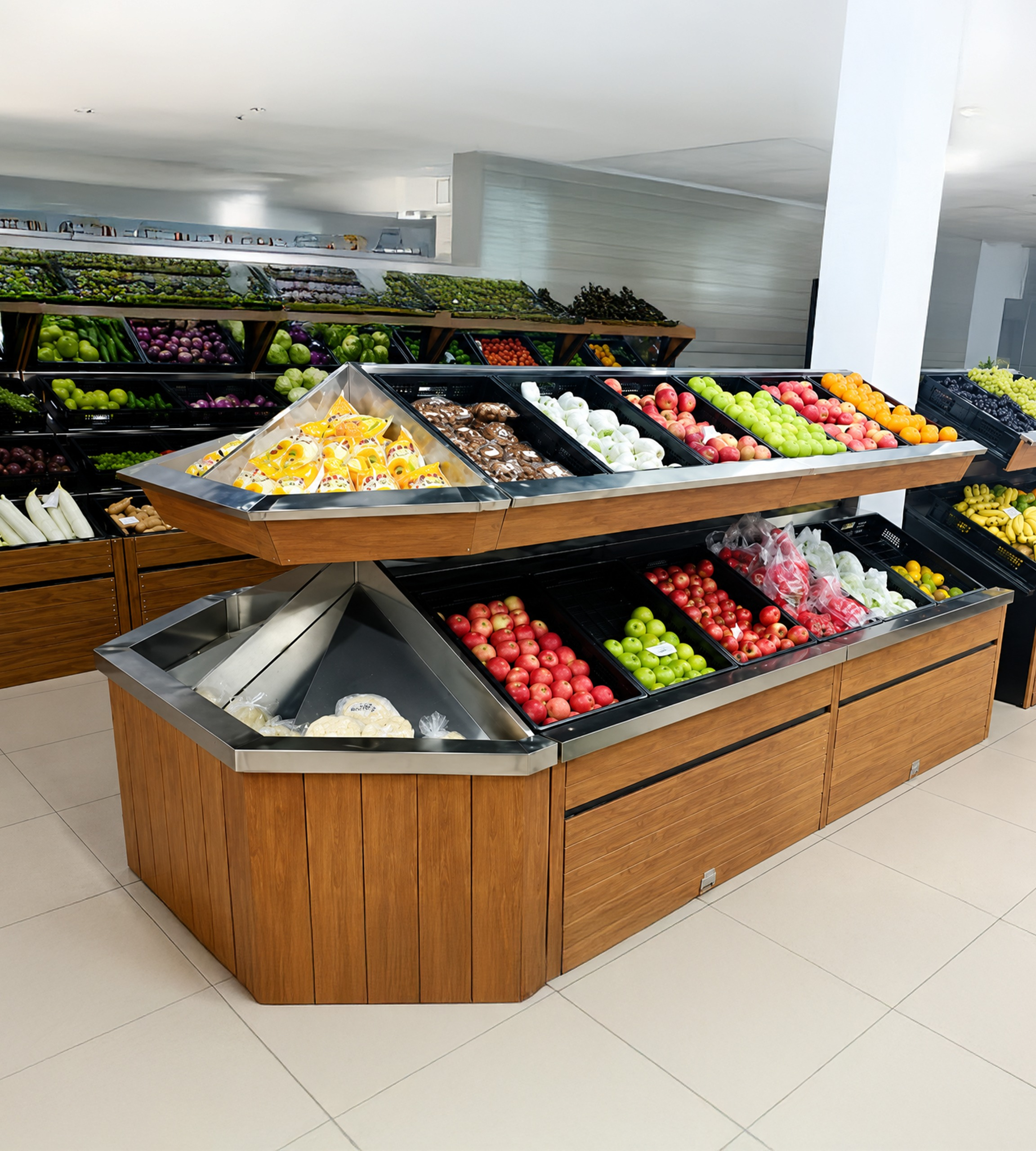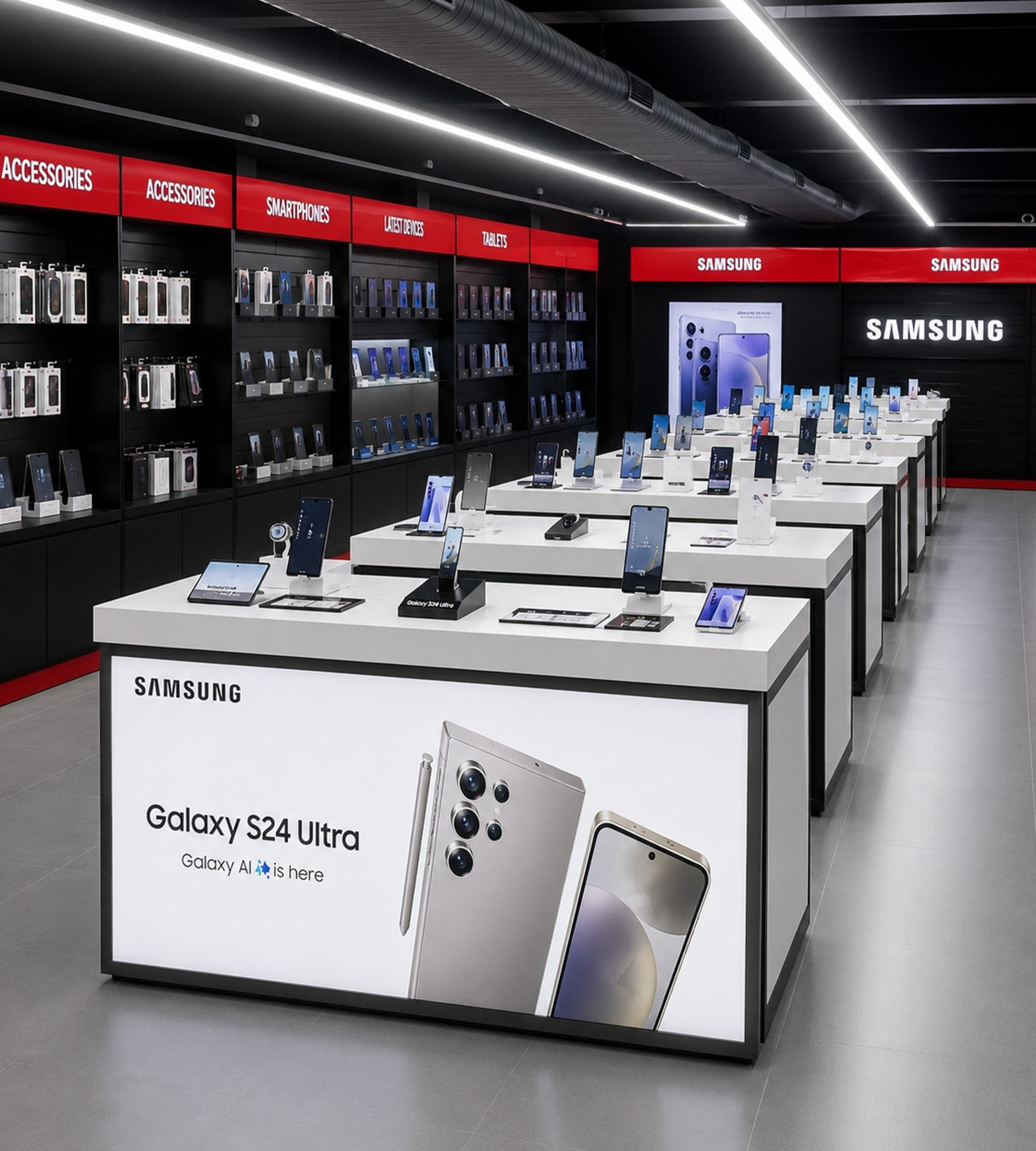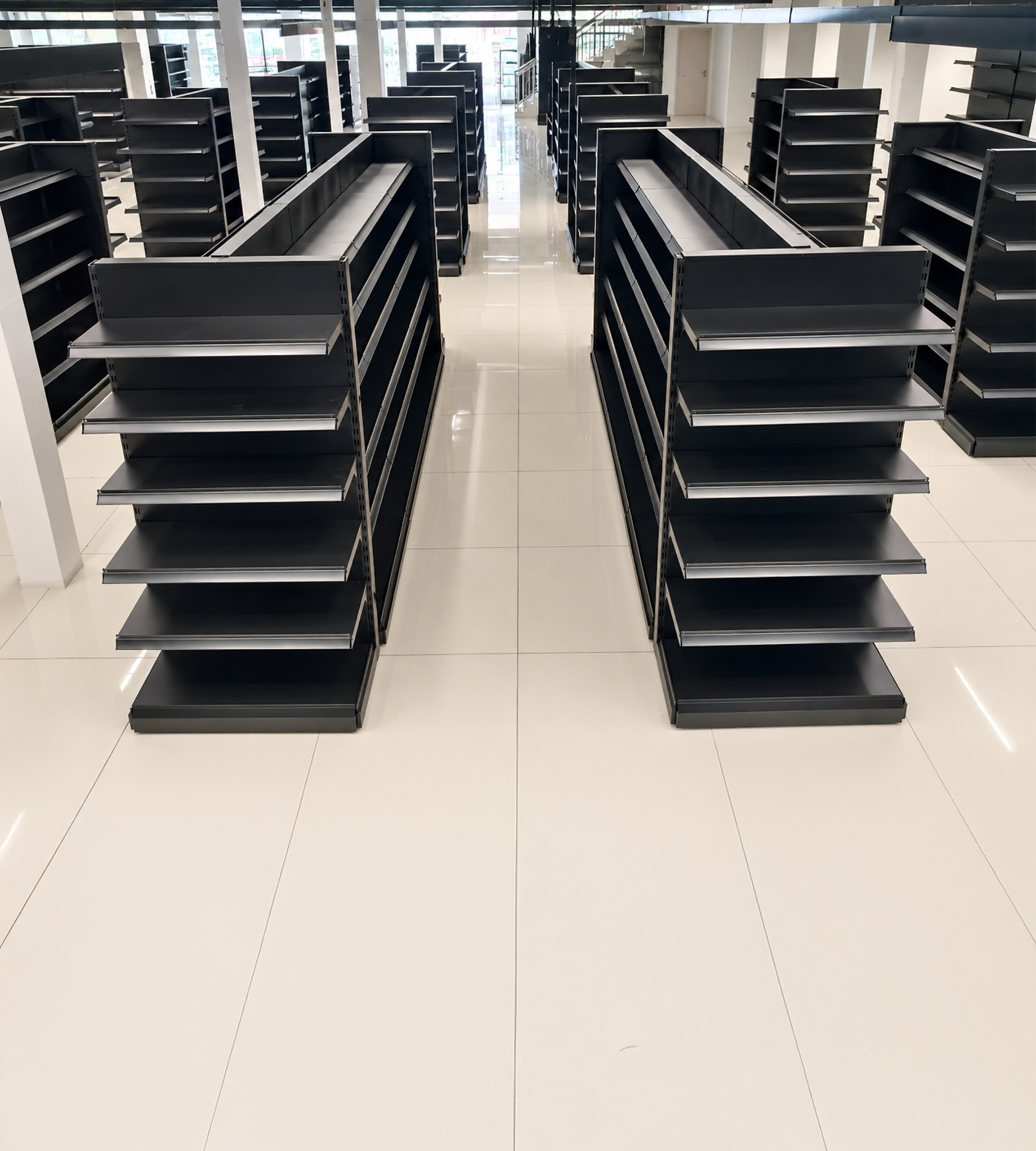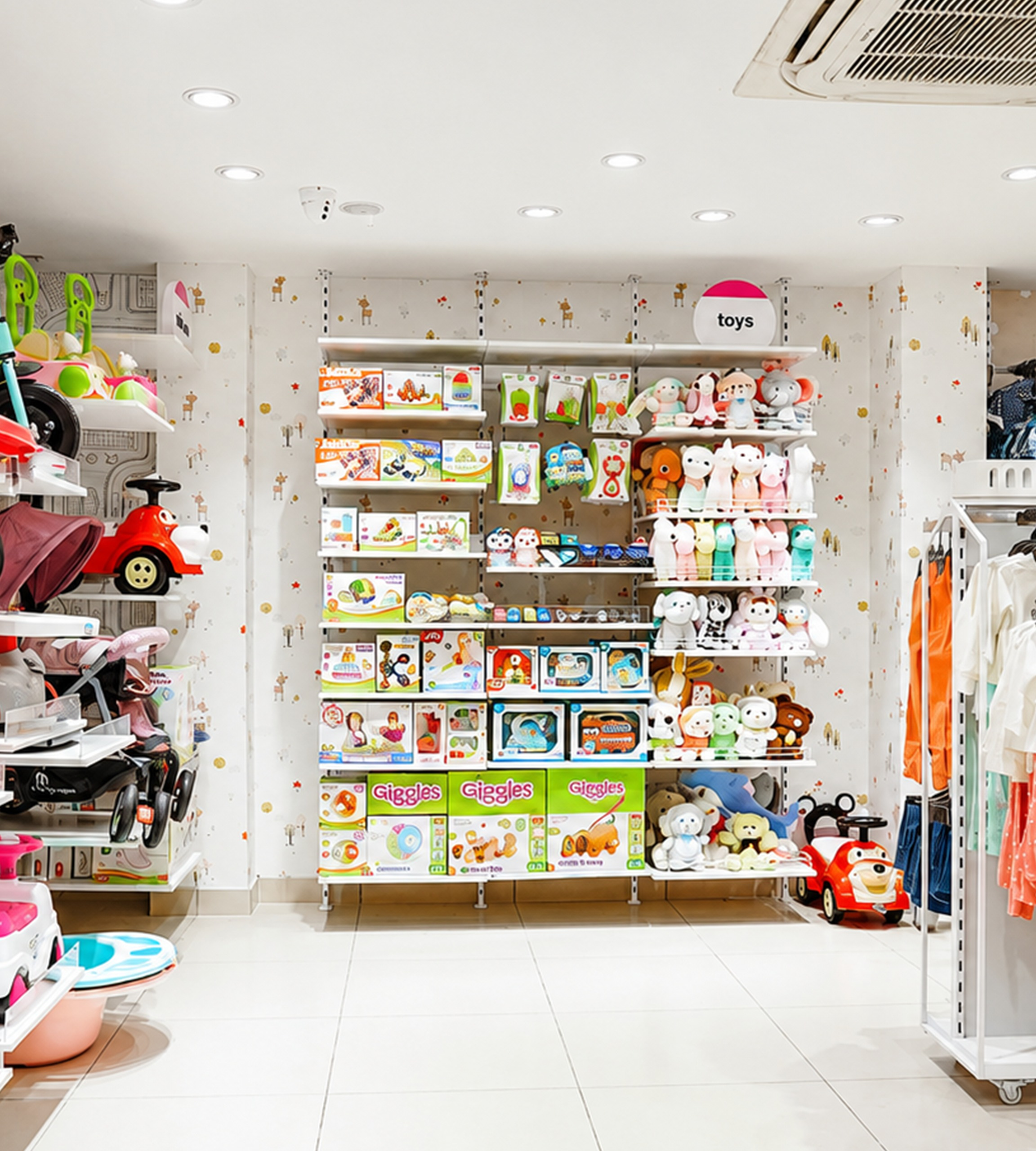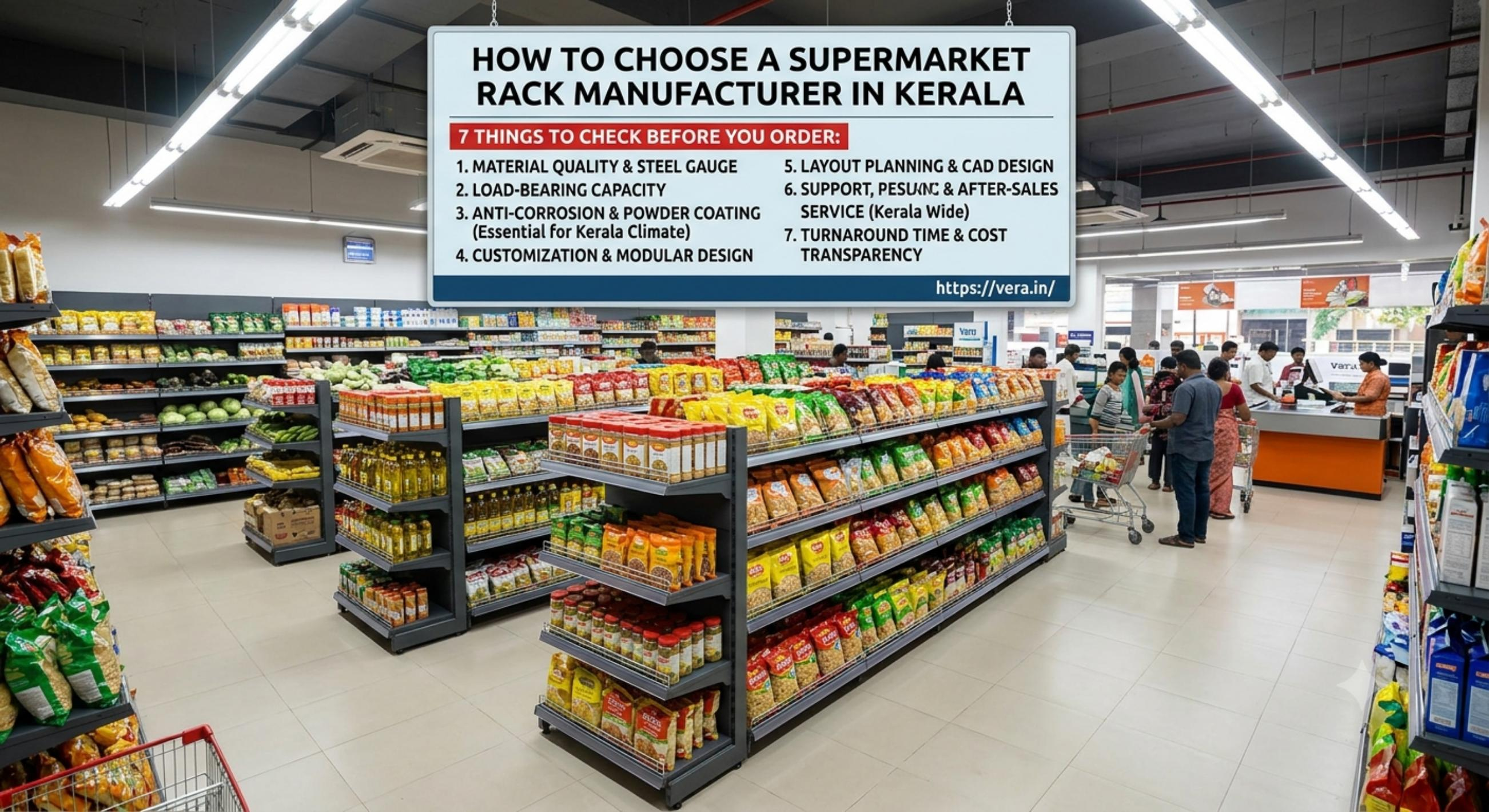
Opening a new store in Kerala is an expensive exercise, and racking is one of the few purchases you live with for the next ten years. Get it right and your store looks organised, stock moves faster, and staff stop wasting time hunting for products. Get it wrong and you are dealing with sagging shelves, rust near the coast, and a supplier who stops answering the phone three months after installation.
The difficulty is that almost every fabricator in Palakkad, Coimbatore, Thrissur and Ernakulam calls themselves a supermarket racks manufacturer. Some genuinely roll, punch, weld and powder coat their own steel. Others buy finished units from a third party and stick a label on them. From a quotation, the two look identical. From year three, they do not.
Here are seven things worth checking before you commit to a supermarket racks manufacturer and release an order.
1. Find out whether they actually manufacture
Start with the simplest question: where is the factory, and can you visit it?
A real display racks manufacturer will have a unit you can walk through — sheet stock, a press, welding bays, a powder coating line, and finished goods waiting for dispatch. A trader will offer photographs and reasons why a visit is inconvenient this week.
This matters for three practical reasons. A display racks manufacturer with its own line controls specification, timeline and price. Manufacturers can modify a design for your store; traders can only sell what the catalogue lists. Manufacturers hold component stock, so a replacement bracket in year four takes days rather than never. And manufacturers quote you the factory price, not the factory price plus a margin.
If you are based in central Kerala, there is a cluster of genuine fabrication units around the Kanjikode industrial belt in Palakkad, which is close enough to most of the state for a site visit to be reasonable.
2. Ask for the steel specification in writing
Racks are sold by appearance and bought by price, which is how thin steel ends up in a lot of Kerala stores.
Ask for the sheet thickness in millimetres for uprights, shelves and brackets, the grade of steel, and the tested load per shelf level. A supplier who manufactures will answer in numbers. A supplier who does not will talk about quality generally.
Thickness is where quotations quietly differ. A shelf at 0.8 mm and a shelf at 1.2 mm look the same on delivery day. One of them bows under detergent cases within a year. When you compare two prices for supermarket shelving systems, make sure you are comparing the same gauge — otherwise the cheaper quote is simply a different product.
Load ratings should be stated per level and honestly. Beverages, rice sacks and cooking oil are dense, and a shelf rated optimistically will show it.
3. Check the finish against Kerala's climate
This is the point most buyers underestimate, and it is specific to our state.
Kerala runs high humidity for most of the year, gets punishing monsoon months, and carries salt air anywhere near the coast. Steel that performs perfectly well in a dry inland climate corrodes here. Chill sections, fish and meat counters and anything near a shutter that stays open all day are the first places rust appears.
So ask how the finish is applied. Proper powder coating involves degreasing, phosphating, rinsing and oven curing before colour goes on. Spray paint over untreated steel is cheaper and fails visibly within two monsoons.
For wet zones, cold storage areas and coastal districts, ask whether galvanised or stainless options are available. A serious manufacturer will recommend a different finish for a Kochi seafront outlet than for an inland store in Palakkad, and will tell you why.
4. Confirm the range covers everything you will need
Retail rarely stays in one category. A supermarket adds a pharmacy counter. A grocery store expands into household goods. A textile outlet opens a second floor.
If your supplier only handles retail display racks, every new requirement means a new vendor, a new lead time, and finishes that do not quite match.
Check whether they can supply the full spread under one roof:
- Supermarket shelving systems for grocery and provision stores
- Wall-mounted and centre gondola retail shelving systems
- End caps, checkout counters and promotional bins
- Pharmacy display racks, medical store racks and dispensing counters
- Garment and textile display systems
- Appliance, mobile and electronics display racks
- Slotted angle racks for stockrooms and back-of-house storage
- Heavy-duty pallet racking for warehouses
Pharmacy work is a useful test of range. A pharmacy racks manufacturer has to handle narrow compartments, clear labelling, controlled-substance storage and quick retrieval — it is a different design discipline from grocery, and suppliers who claim it without doing it tend to deliver grocery shelving with smaller gaps.
The same applies to slotted angle racks. They look simple, so quality varies enormously. Ask any slotted angle rack manufacturer about slot pitch, angle thickness and whether the assembly is bolted or riveted before treating it as a commodity item.
5. Insist on a site survey and a layout drawing
Nobody should quote you a store layout over the phone.
A supplier worth ordering from will visit, measure the space, note the pillars, the shutter positions, the beam heights and the entrance flow, and then produce a drawing. That drawing should show aisle widths, rack positions, bay sizes and the shelf count per bay.
Aisle width is where inexperienced suppliers cause lasting damage. Too wide and you have paid rent for empty floor. Too narrow and two customers with trolleys cannot pass, which quietly caps your billing throughput at peak hours. Kerala stores often sit in converted buildings with awkward pillars and low beams, so a standard layout copied from a catalogue usually wastes several hundred square feet.
Ask to see layout drawings from past projects. Look at whether the drawings account for the building or fight it.
6. Get delivery and installation in writing
Fabrication is one thing. Getting a fully fitted store open on the date you promised your landlord is another.
Before ordering, confirm:
- The production lead time in working days
- Who transports the material and who pays for it
- Whether installation is by the manufacturer's own team or subcontracted
- How many days installation will take
- Who handles damage or shortage during transit
- What happens to the schedule if your civil work runs late
An own-team installation is generally worth a small premium. Crews that assemble the same retail shelving systems every week get levelling, anchoring and alignment right the first time, which is what determines whether your racks still stand straight after five years of trolleys knocking into them.
Ask for two or three completed stores in your district that you can visit unannounced. A supplier with a real project record will share them without hesitation.
7. Understand what happens after installation
The best signal of a supplier's confidence is what they offer once your money has cleared.
Check the warranty — what it covers, how long it runs, and whether it is written or verbal. Check that spare shelves, brackets and uprights will be available in the same dimensions two or three years from now; suppliers who change designs frequently leave you with mismatched additions. Check whether they will come back to add levels, reconfigure a section or shift racks when you renovate, and roughly what that costs.
Finally, look at how they price. A clear quotation lists units, dimensions, gauge, finish, quantity, installation and taxes as separate lines. A single lump-sum figure with no breakup is usually hiding either a thin specification or a thick margin.
Frequently asked questions
What does supermarket racking cost in Kerala? Light-duty retail shelving typically runs in the low thousands of rupees per running foot, with cost driven by gauge, height, shelf count and finish. Heavy-duty pallet racking is priced per bay and costs considerably more. Any figure quoted before a site measurement is a guess.
How long does a store fit-out take? For a standard supermarket, four to six weeks from confirmed order to completed installation is realistic, assuming your civil and electrical work is finished. Fully customised units and large pharmacy fit-outs take longer.
Are pharmacy display racks different from grocery shelving? Yes. Medical store racks use narrower compartments, shallower depths and layouts built around fast retrieval and clear labelling. Grocery shelving prioritises facing area and bulk capacity. Using one in place of the other slows a pharmacy counter down significantly.
Can existing racks be reused or extended? Often, if the original system is modular and the manufacturer still produces the same profile. This is precisely why buying from a manufacturer rather than a trader pays off later.
Planning a store fit-out?
Vera is a supermarket racks manufacturer producing retail display racks, supermarket shelving systems, pharmacy display racks, medical store racks, garment display systems and slotted angle racks from our unit at Kanjikode, Palakkad, with more than 12,000 installations completed across Kerala and beyond. We survey your space, design the layout, manufacture in-house and install with our own team.
Call +91 9061 339 977 or send your floor dimensions on WhatsApp for a free layout estimate.